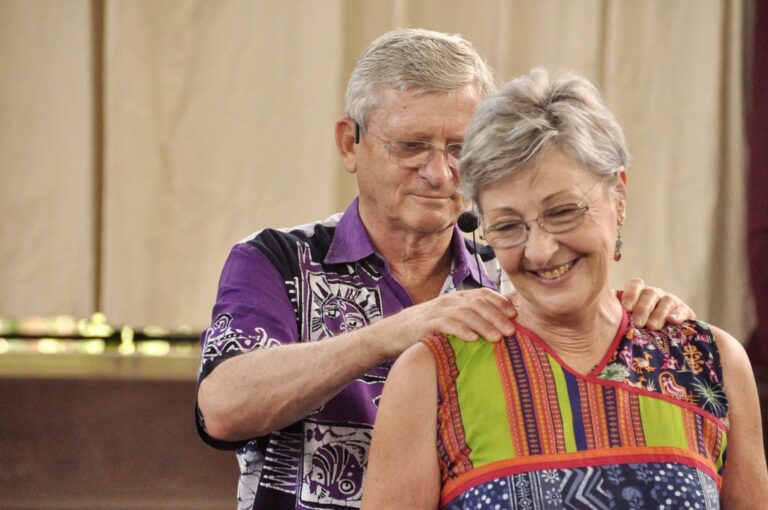
“At the heart of Christian egalitarianism is the belief that our personal qualities and talents largely determine our activities in the home and Church. Egalitarians do not place restrictions or privileges on the basis of gender alone.” — Margaret Mowczko
“There is neither Jew nor Greek, slave nor free, male and female, for you are all one in Christ Jesus.” — Galatians 3:28 (NIV)
“Who, though he was in the form of God, did not count equality with God a thing to be grasped.” — Philippians 2:6 (ESV)

In a world that often divides roles and relationships into rigid categories, the story of man and woman is far richer than we realise. This article invites us to reimagine equality not as sameness, but as mutuality, a partnership where both the man and the woman are seen, valued, and empowered. It’s a call to reclaim the fullness of God’s design, where strength, vulnerability, leadership, and submission are not in conflict, but woven together in a way that honours both. The table is set for both, and the story is wide enough for them to sit together, bringing their unique gifts to the table, side by side.
Egalitarianism Explored
Egalitarianism, often referred to as biblical equality, is grounded in the teachings of Jesus Christ and asserts that there are no inherently male or female roles within marriage, the church, or society. This perspective emphasizes an equal partnership in marriage and affirms that both women and men are equally called to serve as leaders in the church. A key passage often cited to support this view is Galatians 3:28: “There is neither Jew nor Greek, slave nor free, male nor female, for you are all one in Christ Jesus.” For egalitarians, this verse serves as a foundation for the belief that the Gospel transcends gender distinctions, promoting equality in all spheres of life.
To better understand this perspective, I’ve selected four influential proponents of egalitarianism whose work has resonated with a broad audience: Ruth Haley Barton, Richard and Catherine Kroeger, John Stackhouse, and John and Stasi Eldredge. My intention is to explore their arguments and assess whether their positions are compelling and firmly rooted in Scripture.
Ruth Haley Barton
Ruth Haley Barton, a respected author, spiritual director, and founder of the Transforming Center, has been a powerful voice in promoting spiritual growth and leadership. The Transforming Center is dedicated to nurturing leaders through rhythms of solitude, prayer, community, and deepening their understanding of leadership rooted in personal transformation. The Center emphasizes the importance of leaders’ own spiritual development, enabling them to better transform their communities in turn.
Barton’s (cited in Johnson, 2005) egalitarian perspective emerges from her personal reflection and wrestling with Scripture in light of her own leadership gifts. She asserts:
“When a woman is not given access to the same opportunities men are given access to, that is sexism, plain and simple, and all are impoverished because of it. When women are not invited into full leadership and partnership in all aspects of life and church and work, entire leadership groups and whole communities do not benefit from the fullness of the gifts that God has given to the Church through women. This represents stunning losses for the Kingdom of God and for the human community.”
In her writings, such as Becoming a Woman of Strength (2000), Barton critiques the patriarchal structures that have historically limited women’s roles in leadership. Her collaboration with Rob Dixon in Together in Ministry: Women and Men in Flourishing Partnerships (2021) further highlights how frameworks like the Billy Graham Rule and purity culture have restricted women’s access to positions of influence, depriving men and women alike of fulfilling and fruitful partnerships. Barton and Dixon argue that these systems have inhibited true human flourishing, contrary to God’s intended design for mutual empowerment.
Dixon’s research on thriving mixed-gender partnerships identify ten key attributes for success:
- Authentic Learning: Both partners embrace continuous growth and learning.
- Shared Theological Conviction: A mutual belief in the equal partnership of men and women.
- Awareness of Gender Brokenness: A commitment to addressing both personal and systemic gender issues.
- Freely Shared Power: Leadership is grounded in shared authority and influence.
- Embracing Difference: Diversity is valued and seen as enriching the mission.
- Thriving Friendships: Partnerships are rooted in mutual, flourishing friendships.
- Sensitivity to Gender Dynamics: A focus on understanding the complexities of gender relationships.
- Abundant Communication: Open, frequent, and intentional dialogue.
- Contextualized Boundaries: Boundaries are thoughtfully adapted to the needs of each partnership.
- Public Dimension: Partnerships have a visible presence that encourages and inspires others.
For Barton, true leadership arises from a deep care for the soul, both personally and collectively. She emphasizes that spiritual transformation and inner reflection are not merely secondary but essential to authentic leadership and flourishing relationships. Her egalitarian stance, therefore, seeks to empower women by affirming their full participation in leadership, drawing from both theological conviction and lived experience.
Richard and Catherine Kroeger
Richard Kroeger, a Presbyterian minister, and Catherine Clark Kroeger, a respected American writer, professor, and New Testament scholar, co-authored I Suffer Not a Woman: Rethinking 1 Timothy 2:11-15 in Light of Ancient Evidence (1998), which addresses one of the most debated passages regarding women’s roles in ministry. The book is framed as a response to those who struggle to reconcile the desire for greater leadership roles for women with a commitment to Scripture. The Kroegers explore whether Paul’s instructions in 1 Timothy 2:11-15 genuinely forbid women from exercising leadership and teaching gifts, or whether Paul was specifically addressing a cultural issue in the church at the time.
The Kroegers propose that the problem Paul was reacting to was not the presence of women in leadership, but a heretical myth being spread by some women in the church, an error that would later contribute to the rise of Gnosticism. Their careful exegesis of the Greek text of 1 Timothy 2:11-15, along with its historical context, reveals that Paul’s instructions were likely a response to a particular issue within the Ephesian church, rather than a universal prohibition of women’s leadership in the church.
The Kroegers argue that a closer look at the first-century cultural and theological context in which Paul wrote sheds new light on the passage. By examining the role of women in the ancient world and the specific issues that were plaguing the church in Ephesus, they offer a fresh and responsible interpretation of 1 Timothy 2:11-15. Their scholarship provides a compelling case for a broader, more inclusive understanding of women’s roles in the church, challenging the traditional view that women should be excluded from leadership and teaching roles.
The Kroegers’ work significantly contributes to the egalitarian perspective by offering an alternative reading of a pivotal biblical passage, encouraging the church to reconsider its understanding of Scripture in light of historical, cultural, and linguistic insights. Their interpretation opens the door for women to participate fully in ministry and leadership, affirming their spiritual gifts and contributions to the body of Christ.
John Stackhouse
John Stackhouse Jr., a respected Canadian scholar of religion and author, offers a thoughtful and conservative approach to egalitarianism in his book Partners in Christ: A Conservative Case for Egalitarianism (2015). Stackhouse begins by acknowledging that many New Testament passages seem to suggest women’s submission to their husbands and limitations on women in church leadership. However, he argues that these directives were given to help the gospel advance within the patriarchal cultural constraints of the time, rather than as permanent prescriptions to uphold patriarchy.
Stackhouse challenges both conservative and liberal interpretations of these texts. He rejects liberal approaches that suggest the Bible contains contradictions or that some parts might be “corrections” of others. As he states, “This suggestion that parts of the Bible should be read as corrections to other parts… will be nonsense for traditional Christians who understand God to be, in fact, the Author of the Bible behind and within all of the various human writers of its component parts” (p. 146). Stackhouse’s stance is clear: Scripture should be read holistically and consistently, without diminishing its authority.
He also critiques the antagonism and division that has often marked the debate over women’s roles, expressing a desire for positive engagement and reflection. His prayer, as he shares, is that any provocation from this debate would lead to “positive reflection and spiritual fruit,” benefiting both men and women in service to God’s kingdom (p. 132).
A key aspect of Stackhouse’s argument is his view on cultural context. He suggests that in a patriarchal society, the church wisely conformed to the social order in order to avoid scandal, even as the New Testament teachings improved the status of women compared to the norms of the time. Now, in our modern, at least officially egalitarian society, Stackhouse contends, the true scandal is that the church has not fully embraced the freedom to allow women and men to serve according to their gifts and calling without arbitrary gender restrictions. He summarizes this thesis powerfully: “When society was patriarchal… the church avoided scandal by going along with patriarchy, even as the Bible ameliorated it… Now, however… the scandal (ironically enough) is that the church is not going along with society” (p. 71).
Stackhouse’s egalitarianism, while rooted in a conservative reading of Scripture, advocates for the church to fully embrace the modern freedom to honour the gifts and callings of both women and men equally, marking a shift away from outdated patriarchal structures. His perspective highlights the importance of understanding the historical context of Scripture while also embracing its call to a more egalitarian partnership in ministry today.
John & Stasi Eldredge
In Captivating: Unveiling the Mystery of a Woman’s Soul (2013), John and Stasi Eldredge offer a perspective that is difficult to categorize, blending elements of biblical femininity with a more personal, heart-centred approach. John, a counsellor, author, and the president of Wild at Heart, and Stasi, an author and speaker, acknowledge the distinctions between the sexes but resist presenting a rigid, formulaic version of “biblical womanhood.” Rather than focusing solely on traditional roles like homemaking, mothering, and hospitality as a counter to feminism, the Eldredges centre their message on the heart, drawing inspiration from Proverbs 4:23: “Above all else, guard your heart, for everything you do flows from it.”
Their portrayal of femininity is not confined to external roles but taps into the deep, sacred desires of the woman’s heart. The Eldredges write:
“Every song you love, every memory you cherish, every moment that has moved you to holy tears has been given to you by the One who has been pursuing you from your first breath in order to win your heart. God’s version of flowers and chocolates and candlelight dinners comes in the form of sunsets and falling stars, moonlight on lakes and cricket symphonies, warm wind, swaying trees, lush gardens, and fierce devotion. And this romancing is immensely personal. It will be as if it has been scripted for YOUR heart. He knows what takes your breath away, knows what makes your heart beat faster.”
Their vision of femininity is rooted in three deep, universal longings they believe every woman shares:
- To be romanced: To feel pursued and cherished, as if she is precious.
- To play an irreplaceable role in a great, shared adventure: To be desperately needed for her unique contributions.
- To unveil beauty: To embody and reveal a beauty that captivates and inspires.
By framing femininity this way, the Eldredges challenge cultural stereotypes that narrowly define what it means to be a woman. They encourage women to embrace their God-given roles with courage and confidence, recognizing their inherent worth and divine purpose.
For the Eldredges, understanding the image of God requires a broader view. They argue that in the Garden of Eden, both masculinity and femininity reflected God’s image, with each playing a vital part in His larger story, a love story set against the backdrop of a world at war. The Fall, however, disrupted femininity, causing women to hide, symbolized by the fig leaves. Yet, they believe that behind every fig leaf lies a broken heart, and it’s essential for women to understand their story and bring it to Scripture. Restoration, they suggest, involves heart-level healing, as women join Jesus in His mission and learn to love themselves, God, and others.
One of the most controversial parts of Captivating is the claim that “Eve is God’s relational specialist given to the world to keep relationship a priority… Women are needed to protect relationships, bring them back to centre stage where they belong… Because of the Trinity, relationship is the most important thing in the universe.” This idea has sparked considerable debate, with some critics accusing the Eldredges of placing the responsibility for men’s responses on women. Furthermore, the book’s reliance on popular culture, movies, and personal anecdotes rather than deep, theological engagement with Scripture has drawn criticism.
A particularly scathing review from the Overflowing Heart Reviews (Krista, 2011) criticizes Captivating for its lack of theological depth and its sentimentalized portrayal of femininity. Krista argues that, while the Eldredges’ aim to empower women is commendable, their approach falls short of providing a biblically grounded, holistic vision of womanhood. In her review, she writes:
“I’ve attended several of the Captivating retreats held by Ransomed Heart. I do not recommend attending them whatsoever. They’re very nonsensical. Almost all of the retreat deals with the “heart”, but they purposefully tug at yours by playing movie clips at each speaker session. It’s all about creating that false sense of a heart “warmed” and “tenderized”. It looks and feels very manipulating. I almost felt as though it was slight on the church/power abuse spectrum. Most women though will lap this up because they’re thirsty for something. Just be careful you are drinking from the correct cup.”
Though some may feel this critique holds weight, my personal experience attending a Captivating Women’s Event in Australia in 2017 was entirely different. After having previously felt burnt out by women’s retreats and conferences, I attended the event with my adult daughter, encouraged by my husband, who had attended the Wild at Heart retreat. Our understanding was simple: if the event didn’t resonate with us, we would leave rather than sit in frustration.
What transpired during that retreat, however, was difficult to put into words. Both my daughter and I experienced something deeply moving, and although we came to this experience independently, we both felt that God came for our hearts. The Eldredges set the stage, but it was the Holy Spirit who did the transformative, restorative work within us. Long-held strongholds regarding our identities were dismantled, and in their place, we felt a new sense of lightness and freedom, a freedom that has remained with us since.
In summary, while the Eldredges’ Captivating has drawn mixed reactions, it undeniably challenges many misconceptions about feminine identity and purpose. Their approach, centred on heart and relationship, encourages women to rediscover their worth in God’s eyes and to embrace the journey toward healing and restoration. For some, this message may resonate deeply, as it did for me, offering a fresh perspective on womanhood that connects to both the heart and the divine.
My Response to Egalitarianism
While I resonate with the well-reasoned arguments put forth by egalitarian writers like Stackhouse, I find myself continuing to wrestle with how these ideas play out in the present day. The balance between cultural pragmatism and timeless theological truth can feel elusive. Egalitarianism offers a compelling vision of mutual partnership and the flourishing of both men and women, yet many lived realities of gender roles in contemporary society complicate the full embrace of this vision. The journey toward understanding and living out true equality in the church and in the world remains a work in progress for many of us.
The question I continue to grapple with is this: How do we align Scriptural principles with the complexities of modern relationships, leadership, and gender dynamics in a way that truly reflects God’s heart, for flourishing, for equality, and for mutual respect?
So, who is right? The debate between complementarianism and egalitarianism remains deeply polarising. But perhaps the more pressing question, especially for those bearing soul wounds from relationships, churches, or teachings, is not simply which side is biblically correct, but rather: What vision of manhood and womanhood brings life, healing, and dignity?
Can a theology that prescribes fixed roles for men and women truly reflect the heart of Christ, the One who consistently elevated the lowly, dignified the broken, and invited all to participate fully in His kingdom?
Closing Thoughts
The debate surrounding gender roles within Christian faith communities is complex, with passionate voices on both sides. Whether one embraces complementarianism or egalitarianism, the central question remains: How can we best reflect God’s image in our relationships, leadership, and service to one another?
For some, the scriptural call to submission and order in relationships holds deep theological significance. For others, the journey toward understanding womanhood is not about conforming to rigid roles or external expectations, but about embracing one’s unique identity and purpose within God’s larger story.
Ultimately, the transformative work of the Holy Spirit, as I’ve experienced personally, reveals that true freedom and healing come when we allow God to redefine our identity beyond cultural categories or theological labels. Whether we see through the lens of complementarianism or egalitarianism, our aim should always be to honour God, love others well, and walk in the freedom Christ has made possible.
Whether we find ourselves leaning toward complementarian or egalitarian theology, or somewhere in between, the deeper invitation is to become the woman God created us to be. Not caricatures shaped by cultural norms, nor roles constrained by fear or pride, but women of wisdom, strength, and courage who reflect God’s heart in a hurting world.
In our next article, we look to an ancient Hebrew phrase that has inspired generations: Eshet Chayil, “woman of valour.” In a world where womanhood has too often been distorted, diminished, or debated, what does it mean to live with the courage to be woman?
Declarations
I declare that my identity is rooted in Christ, not in cultural expectations or societal labels.
I declare that I am created in God’s image, with unique gifts and strengths, and I will use them to serve others and bring glory to Him.
I declare that my worth is not defined by my gender, but by the love and grace of God that calls me His own.
I declare that I will walk in the freedom and lightness that comes from embracing my true identity in Christ, and I will not allow past hurts or misconceptions to define me.
I declare that I will honour and respect the roles and gifts of others, recognising that both men and women are equally valued in God’s Kingdom.
Prayer
Heavenly Father,
Thank You for creating me in Your image, with a unique purpose and calling that reflects Your glory. I come before You today, acknowledging that my identity is found in You alone, not in the roles or labels that the world places upon me. I ask You to renew my mind and heart, so that I may fully embrace the truth of who I am in Christ.
I surrender my heart to You, knowing that You are the only One who can lead me into the fullness of my calling. Whether I am serving in the home, in the workplace, or in the church, I trust that You have equipped me for the work You’ve set before me. May my actions reflect Your love and grace, and may I honour the gifts and roles of others as we work together to build Your Kingdom.
Holy Spirit, guide me in every step I take. Give me wisdom, courage, and discernment as I seek to live out my purpose in this world. Help me to love well, to serve faithfully, and to be a witness of Your transforming power. May I never forget that I am part of a larger story, a story of redemption and grace, and I choose to walk in that story with confidence and hope.
Thank You, Lord, for the freedom I have in Christ. May my life reflect Your truth, and may I bring glory to Your name in all that I do. In Jesus’ name, Amen.
Reflection Questions
- How has your understanding of biblical womanhood been shaped, by your family, church tradition, culture, or personal experience?
- What beliefs or assumptions might need revisiting in light of your journey with God?
- When you consider the voices of scholars, writers, and teachers on gender roles, which perspectives resonate most deeply with your heart? Explain.
- Have you experienced wounds related to gender expectations or teachings about your role as a woman?
- What does it mean to you personally to reflect God’s image as a woman?
- How might the Holy Spirit be inviting you to live more fully into your God-given identity?
- In your own life, what does courage look like in stepping into the fullness of who God has made you to be?
- Are there areas where you sense God calling you to rise, risk, or release?
About the Author

Dr. Paula Davis, a clinical counsellor, supervisor and educator with three advanced degrees, specialises in trauma counselling, and before she retired, was a senior lecturer in counselling, designing and delivering curricula. Her book, “Eating Water, Drinking Soup: Finding Nourishment in the Deepest Pain” is available on request. With her husband, she delivers marriage programs internationally. In 2021, they published “A Safe Place: A Marriage Enrichment Resource Manual” available on online bookstores. While she derives fulfilment from making a positive impact, she also appreciates the simple pleasures of life, such as spending time with her husband over coffee or engaging in outdoor adventures. Never one to be deterred by challenges, she has undertaken skydiving, cage-diving with great white sharks in South Africa, walking with African lions, and zip-lining across the Victoria Falls gorge.