

“For communication to have meaning it must have a life. It must transcend “you” and “me” and become “us” … In a small way we then grow out of our old selves and become something new.” — Hugh Prather
“We’re never more fully alive and complete than when we experience God working through us and in spite of us in a way that changes someone’s life right before our eyes. Nothing compares to the wonder of seeing God’s goodness and glory break through – and knowing we played a part in it.” — Bruce Wilkinson, You Were Born for This
“It’s not what you look at that matters, it’s what you see.” — Henry David Thoreau

The Power of Perception
In the dance of relationships, perception is everything. It shapes how we see and feel about one another and ultimately determines the depth of connection we can achieve. The power of perception, especially in close relationships, lies in the creation of safety, where both people feel truly seen, heard, and valued. When that safety is present, it fosters emotional healing, allowing old wounds to be revisited and, more importantly, repaired.
This concept is rooted in what therapists call a “corrective emotional experience,” where the relationship itself becomes a safe space to process pain in new, healthier ways. Similar to a mother providing a secure environment for her infant, this emotional safety allows for vulnerability and transformation.
When I reflect on moments with my husband, I recall times when his presence, steady and non-defensive, created the space for me to confront and heal from my own buried hurts. It wasn’t about fixing the problem; it was about creating a space where my vulnerability could be met with care and understanding.
Deep healing can begin when we feel seen and understood. As we practise this in our marriage, we are learning that healing unfolds through ongoing trust, love, and mutual support. The safety we experience together can also shape how we relate to others.
Feeling accepted and supported as we work through difficult emotions can help us become more open and trusting in other relationships. As our way of relating changes, others may respond differently too. By offering this same safety to our spouse, listening, accepting, and staying emotionally present, we create space for their healing and growth as well as our own.
I remember sitting on the edge of our bed one evening after a particularly tense day. I had been short with my husband, frustrated over something trivial that had scratched at a deeper pain I hadn’t yet named. He didn’t defend himself. Instead, he quietly said, “I can see something’s really hurting you. I’m here.” That moment undid me. His steadiness, his refusal to turn away, became a holding environment, one where I felt safe enough to let the tears fall and eventually find words for my ache. It wasn’t about fixing me; it was about seeing me.
That’s what safety feels like.
After many years of navigating life together, through joys, struggles, and everything in between, my husband and I are still creating this kind of safe holding environment for each other. It doesn’t happen overnight, and it certainly isn’t always easy. But as we learn to trust, to listen, and to truly see one another, our relationship is becoming a place where we can revisit old wounds, not to be trapped by them, but to heal.
One morning over coffee, I shared a story from my childhood that I’d never told him. I was tentative, unsure if it would sound silly or too raw. He didn’t rush me. He just reached across the table, touched my hand, and said, “I’m really honoured you trust me with this.” That response, so simple, spoke volumes. In that moment, love reached down into a wounded part of me and gently whispered, “You’re safe now.”

Helping Another to Share
Creating a sense of safety is key to helping those closest to us open up. When we create a space where someone feels truly seen and heard, we give them permission to be vulnerable. And in doing so, we don’t just love them, we also grow in our own identity, learning to use our voice as we help others find theirs.
Some helpful questions to ask ourselves:
- Can I handle my own emotions and the emotions of others?
- Can I let my loved ones feel what they feel without pushing them toward what makes me more comfortable?
- Is my instinct to punish or blame?
- Do I recognize that someone else’s experience might be different from mine?
- Do I truly want to improve our relationship, deepen communication, and break free from unhealthy cycles?
Creating this kind of emotional safety is essential for change. Dorothee Sölle (1975, p. 76) explains that the sufferer must find a means of expressing and identifying their suffering; mere representation by others is insufficient. If we are unable to discuss our afflictions, we will succumb to their condition or succumb to apathy. Without the ability to communicate with others, there is no possibility of transformation. To become mute, to sever all connections, is equivalent to death.
Safety requires vulnerability, too. Love demands a complete surrender. The encounter in love is an encounter devoid of weapons. Can we ever meet a friend or a stranger without any defences? Can we reveal ourselves to another in our complete vulnerability? (Nouwen, 1997, pp. 22–23). In other words, we can’t help someone else open up if we’re unwilling to be open ourselves.
I recall a season in our marriage when one of us was carrying the hidden weight of grief. My husband had been quietly struggling, but instead of voicing it, he withdrew. It wasn’t until I shared my own heartache with tears, without accusation or expectation, that he finally let down his walls. Vulnerability met vulnerability. We both discovered that sharing pain didn’t create distance; it drew us closer.
Nouwen (2007, p. 38) beautifully describes this in Out of Solitude:
“When we honestly ask ourselves which person in our lives means the most to us, we often find that it is those who, instead of giving advice, solutions, or cures, have chosen rather to share our pain and touch our wounds with a warm and tender hand.”
We can’t know someone any deeper than we’re willing to know ourselves.
Brené Brown (2019) talks about the tension we feel with vulnerability: “It’s the first thing I look for in you, and the last thing I’m going to show you.” Like many of us, she was taught to avoid vulnerability at all costs, but her research revealed that the more we’re willing to be vulnerable, the deeper our connections become.
If the answer is no, we disengage. If we don’t see vulnerability in someone else, it’s hard to connect with them. Real engagement and connection require that we push past shame and take risks in our relationships. Through love, I acquire knowledge, and I am able to approach you without disregarding the reality I perceive (Hobe, 1985).
Safe Conversations
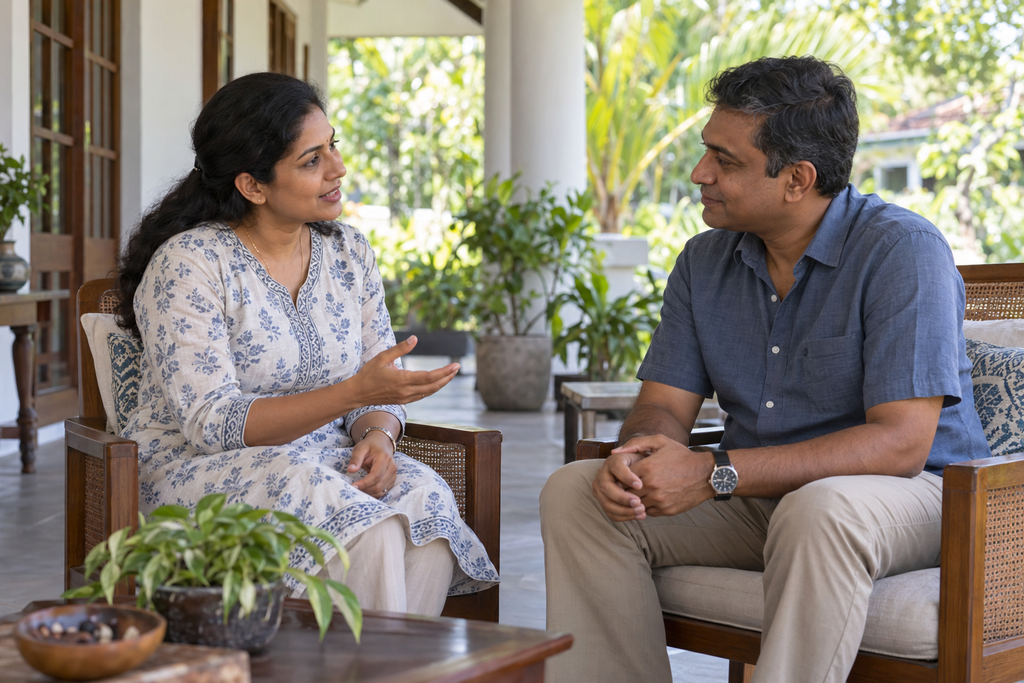
Having safe and healthy conversations between a husband and wife is crucial for maintaining a strong relationship. To begin, we may want to say:
“Hey, I want us to always feel safe and respected in our relationship. How can we make sure we both feel heard and understood, especially when things get tough? I think it’s really important that we communicate openly, and if something ever bothers us, we address it calmly. How do you feel about that?”
I remember one such conversation at the end of a long week when both of us were stretched thin. I started with, “I don’t want to argue, I want us to understand each other better.” That small phrase set the tone. It invited collaboration, not conflict.
Here are a few key principles that can help ensure conversations are productive, respectful, and safe:
- Create a Safe Environment – If one of us is too upset, it’s wise to pause. We’ve learned to say, “I care about this conversation, but can we revisit it when we’re both more grounded?”
- Use Active Listening – A few months ago, my husband said, “So what I’m hearing is that you felt abandoned in that moment?” I nodded through tears, thankful for the mirror he held up to my heart.
- Communicate Clearly and Kindly – “I felt overwhelmed when the plans changed last-minute” opens a door, while “You never think about me!” slams it shut.
- Be Patient – Sometimes, it takes me a while to put words to emotions. The silence can feel awkward, but we’ve learned to honour it as sacred space.
- Be Open to Compromise – We once disagreed about how to spend a weekend. Instead of arguing, we listened to each other’s hopes and made a plan that included both solitude and connection.
- Stay Calm and Control Your Emotions – One night, things got heated, and I blurted something unkind. My husband gently said, “Let’s take a pause, I want to respond, not react.” That break changed the trajectory of our evening.
- Agree to Disagree (Sometimes) – We’ve learned that unity doesn’t require uniformity. Love holds space for difference.
- Prioritize the Relationship – At the end of the day, I often remind myself: “Do I want to be right, or do I want us to be close?”

Safe, Empathic Connection
Empathy in marriage is foundational for safety, trust, and connection. It goes beyond understanding each other’s words and actions, it’s about feeling with our spouse, responding to their emotional world with love and patience.
Some ways empathy shows up in our marriage include being fully present. I think of a night we sat outside watching the sunset, and I quietly said, “I’m feeling kind of lost today.” My husband didn’t offer advice. He just said, “I’m right here with you.” That’s empathy.
Being present means slowing down, putting down the phone, and making eye contact. It means asking, “What do you need right now?” and then actually listening. It means noticing when our spouse seems off and gently drawing them out with warmth and curiosity rather than frustration.
Empathy is choosing to understand before being understood. It’s the quiet power of simply showing up, again and again.

Closing Thoughts
Creating a climate of safety is essential for vulnerability and authenticity to thrive. While there’s no perfect formula for communication, at its heart, communication is about knowing and being known. When safety is present, it paves the way for corrective emotional experiences, where old wounds can heal, and deeper understanding can take root.
A safe space is cultivated by listening beyond the words, seeking to understand the emotions and unspoken messages beneath them. This involves asking thoughtful questions, listening reflectively, summarizing key points, validating and accepting emotions, offering encouragement, and practicing empathy.
Ultimately, meanings aren’t found in words; they are found in people. When a climate of safety is established, the perception of being liked, appreciated, valued, and respected naturally flourishes, strengthening the foundation of every relationship.
As we learn to cultivate emotional safety through presence, empathy, and vulnerability, we create sacred ground where love can take root and flourish. But even the most tender and trusting relationship can face hidden threats, those subtle “foxes” that creep in unnoticed, gnawing at the vines of intimacy before we realize what has been lost.
In the Song of Songs, the lovers cry out, “Catch for us the foxes, the little foxes that ruin the vineyards, our vineyards that are in bloom” (Song of Songs 2:15). These small disruptions, unspoken resentments, emotional withdrawal, busyness, or unresolved hurt can slowly chip away at the heart of connection. In the next blog post, we’ll explore how to guard the tender vineyard of love, recognising and naming the foxes that threaten our intimacy and learning how to protect what is most sacred between us.
Declarations
I declare that my relationships are a gift from You.
I declare that creating a climate of safety is rooted in vulnerability, authenticity, and the deep desire to know and be known.
I declare that I will listen more than I speak, seeking to understand the heart behind the words. I will look for meaning in the person, not just in what is spoken.
Prayer
Lord,
Grow in me a love that is patient and kind, a love that does not envy, does not boast, and is not proud. Grow in me a love that does not dishonour others, is not self-seeking, is not easily angered, and keeps no record of wrongs. Grow in me a love that does not delight in evil but rejoices with the truth. Grow in me a love that always protects, always trusts, always hopes, and always perseveres.
Grow in me a love that never fails.
For where there are prophecies, they will cease; where there are tongues, they will be stilled; where there is knowledge, it will pass away.
But Your love never fails. Let this love take root in me, transform me, and flow through me.
In Jesus name, Amen (Adapted from 1 Corinthians 13:4-8).
Reflection Questions
- What does emotional safety look like for me in my relationships? Reflect on the qualities and actions that help you feel safe and secure, whether it’s through open communication, trust, or vulnerability.
- What past experiences have shaped my perception of safety in relationships? Consider how your personal history, including family dynamics and past relationships, may influence how you create or respond to safety in your current relationships.
- How comfortable am I with vulnerability, and what holds me back from being fully open with others? Reflect on your own willingness to be vulnerable and the barriers, such as fear or past wounds, that may make it difficult to share your true self.
- How do I create a safe space for others to express their emotions and experiences? Think about how you respond when others are opening up to you. Are you a good listener? Do you offer understanding and support, or do you inadvertently shut them down?
- What are some small, daily actions I can take to strengthen the emotional safety in my relationships? Consider practical, everyday choices you can make, whether it’s through active listening, showing empathy, or offering reassurance, to build a stronger sense of safety and connection.
About the Author
Dr Paula Davis has spent the last three decades of her life sitting with people in some of their darkest moments, and somehow still believes deeply in hope. A clinical counsellor, supervisor, educator, and self-confessed lifelong student of trauma, Paula has taught, researched, and worked alongside counsellors and communities across Australia and overseas. Her doctoral research explored how Western trauma approaches can be adapted for collective cultures, a passion that continues to shape everything she writes and teaches.
Together with her husband Barry (of over five decades), she has travelled the world helping couples strengthen their relationships and co-authored A Safe Place: A Marriage Enrichment Resource Manual. She is also the author of Eating Water, Drinking Soup: Finding Nourishment in the Deepest Pain, Exploring the Roots of Heartache: The Stories Our Pain Is Trying to Tell, and After the Breaking: Psychological Trauma and Collective Healing.
These days, Paula is officially “retired,” although nobody seems to have told her calendar. She still writes, teaches, mentors, and is forever collecting stories, books, and ideas that help people heal. When she’s not immersed in trauma theory or rewriting chapters for the twentieth time, you’ll probably find her walking along the beach near her home on the east coast of Australia, swimming in the surf, sharing coffee with Barry, or plotting her next overseas adventure. She firmly believes that good conversations, beautiful sunsets, and God’s grace have remarkable healing properties.